Reimagining 1:1s: Why We Built Conversations, Not Meeting Notes
 Ben Price March 18, 2026 10 min read
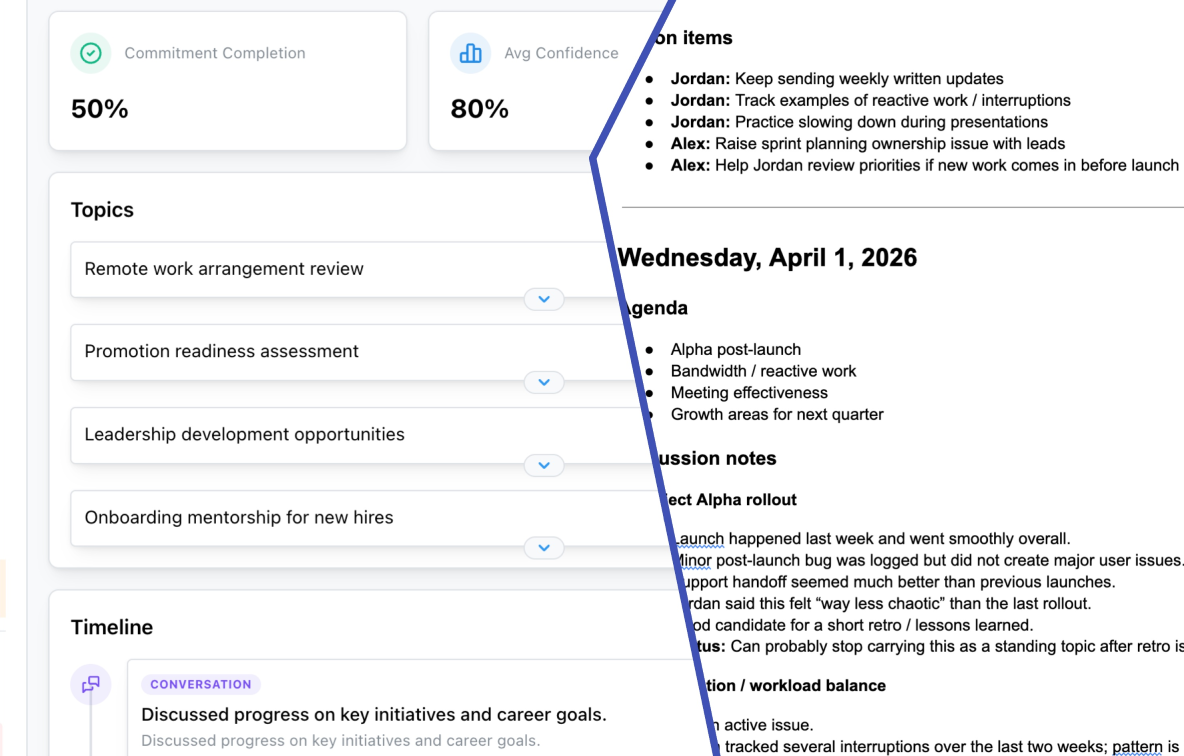
Every manager I know has the same ritual. Five minutes before a 1:1, you open a shared Google Doc, scroll past three months of half-finished bullet points, copy the leftover items to the top, and pretend that constitutes preparation. The meeting happens. Some things get discussed, some don't. You jot a few notes, close the doc, and forget about it until next week.
This is the state of the art for one of the most important activities in management: the 1:1 meeting. A shared doc and a recurring calendar event. That's not a system. It's a workaround that we've collectively agreed to call good enough.
I've managed engineering teams for over a decade, and I've used every variation of this workaround. Notion templates, running Google Docs, Lattice's shared agenda, plain text files. They all share the same fundamental flaw: they treat each meeting as an isolated event. When the meeting ends, the context goes stale. Topics drift to the bottom of the document and quietly die. Commitments dissolve into the noise of last week's notes. The next meeting starts from scratch, and both people end up covering the same ground again.
When we started building Kiboh, this was one of the first things I wanted to fix. Not by making a better shared doc, but by rethinking the data model underneath.
The model: Relationships, Conversations, Topics, and Commitments
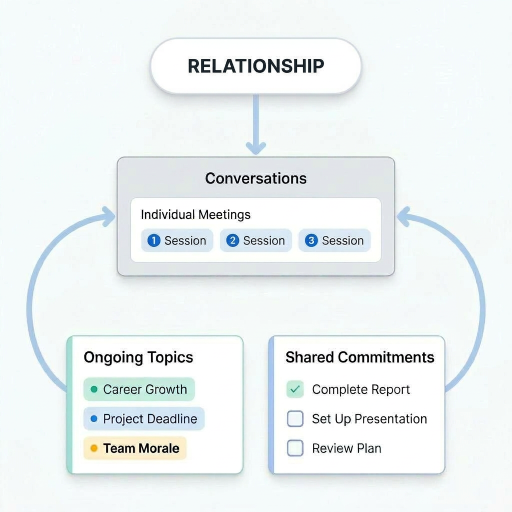
In Kiboh, the top-level concept is the Relationship, not the meeting. When you navigate to someone in the app, you land on a Relationship Dashboard that shows everything about your working relationship with that person: active topics, open commitments, conversation history, and (if you're their manager) coaching signals.
Conversations live inside a Relationship. Each one maps to a single session. You start one, have your meeting, and end it. Topics and Commitments also live inside the Relationship, but they aren't scoped to any single conversation. This is a key design decision. Topics like "Career Growth," "Project Falcon deadline," or "Team morale after the reorg" are long-lived objects. They don't belong to any single meeting. They belong to the relationship between two people, and they persist until someone explicitly resolves or archives them.
This hierarchy matters because it mirrors how real working relationships actually function. You don't stop caring about someone's career growth because your Tuesday meeting ended. You don't forget about a commitment because it was discussed two weeks ago. The data model should reflect that continuity, not fight against it.
Topics that carry forward
Here's how this works in practice. Say you're having a 1:1 with someone on your team and a topic comes up: they're interested in moving into a tech lead role. In Kiboh, you create a topic titled "Tech lead transition" and tag it as Career Growth. You discuss it, and the conversation captures that activity, what was said, what was decided, any concerns raised.
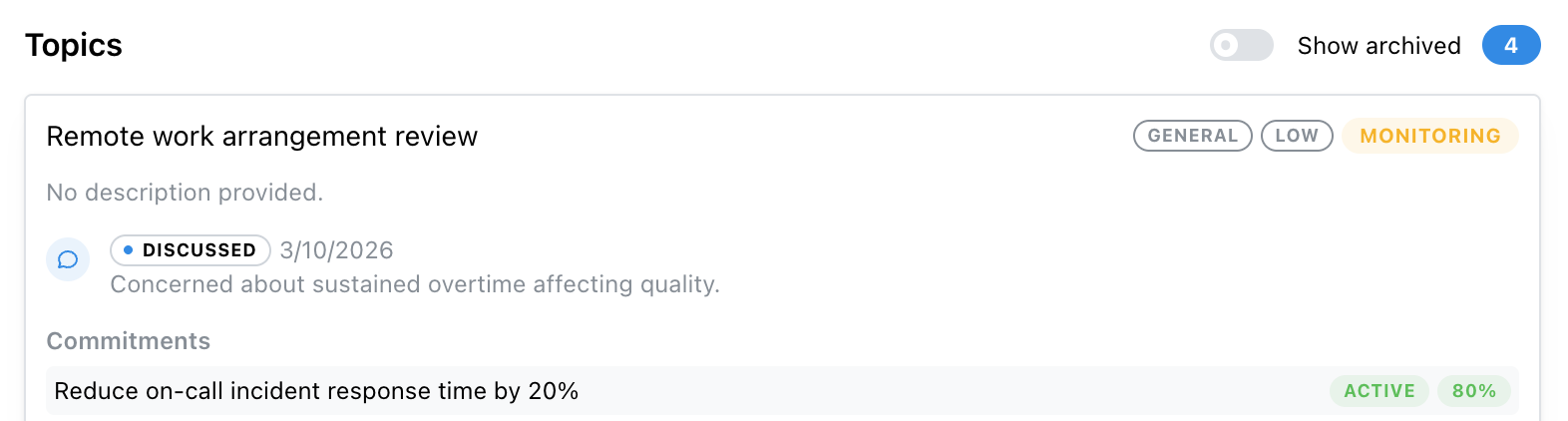
Next week, that topic is still there on the Relationship Dashboard. You don't copy it. You don't scroll past old notes looking for it. It's sitting in the Topics section with its status (Active, Monitoring, Needs Attention), its priority, and a full activity timeline showing every time it was discussed, every insight recorded, every decision made.
Each topic accumulates a rich activity history. The system tracks multiple distinct activity types, from Discussed and Progressing to Blocked, Insights, and Decisions. When you expand a topic card, you see this timeline laid out chronologically with color-coded activities. The "Tech lead transition" topic might show: Discussed on Jan 7, New Insight on Jan 14 ("identified mentorship opportunity with Platform team"), Progressing on Jan 28, additional Notes on Feb 11.
This is the context that shared docs quietly destroy. When you copy-paste topics to the top of a document, you lose the thread. In Kiboh, the thread is the point.
Topics also carry type classifications (Career Growth, Project, Wellbeing, Performance, Team Dynamics, Leadership, General) that let you see, at a glance, whether your conversations are balanced or whether you've been talking about project deadlines for six straight weeks and haven't asked how someone is doing.
Commitments that persist
Commitments work similarly, but with more structure around accountability. When someone agrees to do something in a 1:1, whether it's the manager or the report, that becomes a Commitment. It has a description, an owner, a status, a confidence score (defaulting to 80%), optional success criteria, and a check-in date.
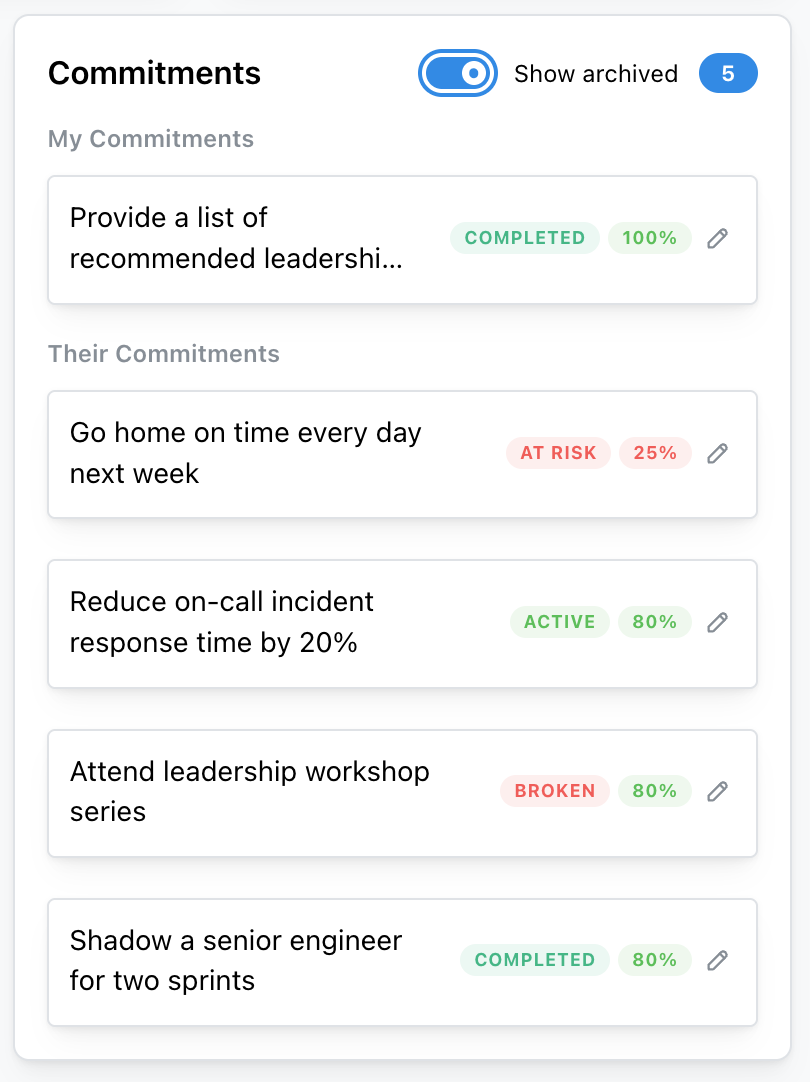
The statuses tell the real story: Proposed, Active, At Risk, Completed, Broken, Closed. That last one, "Broken," might seem blunt, but it's honest. Commitments that just quietly disappear teach both people that promises don't matter. Making the outcome explicit, whether completed or broken, creates a culture where follow-through is visible.
In the Relationship Dashboard, open commitments are always visible in the right sidebar, separated into "My Commitments" and "Their Commitments." During conversation mode, they're surfaced alongside topics so both participants can check in on progress. Each commitment tracks its own activity history with confidence updates, so you can see whether confidence in delivery is rising or falling over time.
Commitments can also be linked to topics. If the "Tech lead transition" topic generates a commitment like "Shadow Sarah on the next architecture review," that link is explicit in the data model. The commitment shows up under the topic, and the topic's activity timeline reflects commitment progress.
This is accountability without micromanagement. Nobody is being tracked against a stopwatch. But when you sit down for your next 1:1, both people can see what was promised and what happened. That visibility is what turns conversations into progress.
Frequency, not rigidity
One decision we made early was to track conversation frequency rather than enforce a calendar cadence. Most 1:1 tools either ignore scheduling entirely or integrate tightly with your calendar and nudge you to maintain a fixed rhythm.
We took a different approach. Kiboh observes your conversation pattern and classifies it: Weekly, Biweekly, Monthly, or Irregular. Some relationships need weekly touchpoints, some need biweekly, some are situational. A manager with eight direct reports shouldn't be forced into the same cadence for everyone. The system should observe and inform, not prescribe.
This rhythm classification is one input into a broader Relationship Health Score that we've built into the product, a composite signal drawn from conversation cadence, commitment follow-through, topic diversity, reflection tone, and more. It's designed to surface whether a relationship is thriving or quietly deteriorating, without requiring anyone to fill out an in-depth survey. We'll go deeper on the health score in a future post. The key idea is that it emerges naturally from the conversations you're already having, not from extra work.

Relationships beyond manager and report
The most important architectural decision, and the one with the broadest implications, is that Relationships in Kiboh aren't limited to the direct reporting line. The system doesn't have a "1:1s" feature bolted onto an org chart. It has a Relationship model that works for any two people in the company.
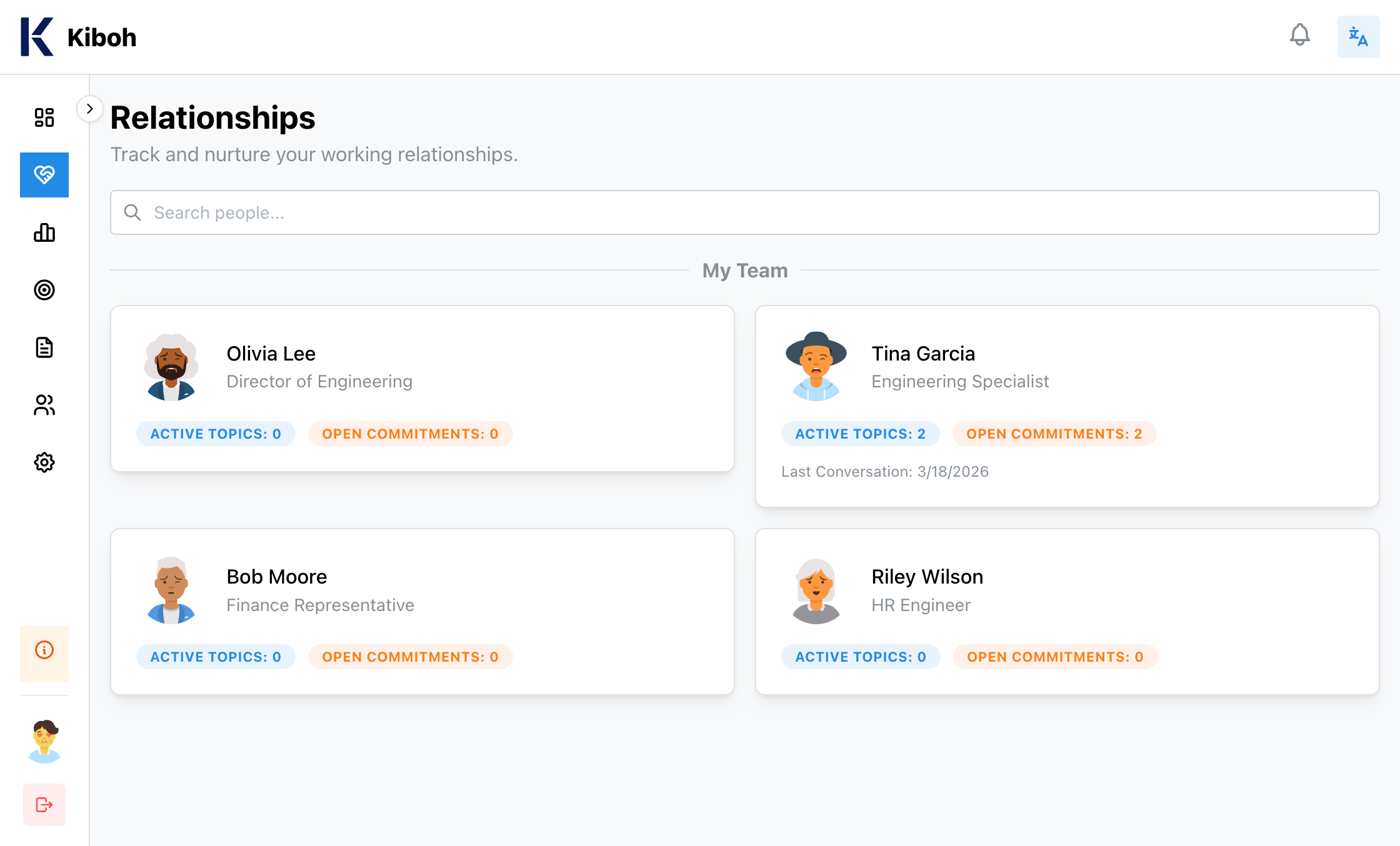
The Relationships index page shows two sections: "My Team" (your direct reports and/or manager) and "Recent" (anyone you've recently had a conversation with). But you can also search for any person in the company and navigate to a Relationship page with them. Skip-level managers can track ongoing topics with people two levels down. Peers working on a cross-functional initiative can maintain shared commitments. A mentor and mentee can build a persistent record of their conversations over months.
The Topics and Commitments model applies identically in all these contexts. The health score and coaching insights are currently scoped to direct manager relationships, but the conversational infrastructure, topics, commitments, highlights, reflections, is available for any relationship.
This reflects something I've believed for a long time: organizations don't run on org charts. They run on a web of relationships. The direct reporting line is the most visible thread, but skip-levels, peer partnerships, mentorships, and cross-functional collaborations are where a lot of the real work happens. Treating those relationships as first-class objects in the system, rather than afterthoughts, is how you build a tool that actually maps to how companies function.
Conversation mode: where it all comes together
When you actually sit down for a 1:1, you enter Conversation Mode. This is a real-time, shared interface where both participants see the same feed of highlights.
As the meeting starts, an AI agent analyzes the full relationship context, active topics, open commitments, recent reflections, signals, conversation rhythm, and even performance data, to generate a prioritized agenda. Each suggested item comes with a priority level, a rationale explaining why it matters right now, and suggested questions to open the discussion. If a commitment's confidence has dropped since last week, the agent flags it. If a topic has been sitting in "Needs Attention" for two conversations, it surfaces that too. The agenda adapts to the relationship: a manager preparing for a direct report conversation sees coaching-oriented suggestions, while the content shifts for skip-level or peer contexts.
The best part is that agenda items aren't throwaway suggestions. If something the agent surfaces deserves ongoing tracking, you can promote it to a persistent topic with one click. It goes straight into the Relationship's topic list, carries forward to future conversations, and starts accumulating its own activity history. The AI proposes; you decide what sticks.
During the conversation, either person can add highlights: Insights, Decisions, Concerns, Topic Updates, or Notes. Each highlight can be linked to a topic, so the activity flows back into the topic's timeline. Commitments can be created on the fly. When the conversation ends, both participants are prompted with a reflection: How did it feel? (Positive, Neutral, Difficult). What's the key takeaway? What needs follow-up? What's unresolved?
Reflections are private by default. In a manager relationship, the report's reflections surface patterns to the manager over time, but neither person sees the other's individual reflection in the moment. Between peers, reflections stay entirely private. This is deliberate: honest reflection requires safety, and safety requires knowing your words won't be read by the person sitting across from you.
The entire conversation syncs in real time. Both participants see highlights appear as they're added. It's not a meeting notes tool. It's a shared experience that captures what actually happened and routes it to where it matters: back into the topics, commitments, and signals that form the ongoing relationship.
A different way of thinking about working relationships
The 1:1 meeting is the most visible surface of something much larger. It's where topics get discussed, commitments get made, concerns get raised, and trust gets built or eroded. But the real value isn't in any single meeting. It's in the continuity between meetings, the accumulation of context, follow-through, and mutual understanding over months and years.
That's what we built Kiboh to capture. Not better meeting notes, but a system that treats working relationships as living, evolving things worth tracking properly. Topics that carry forward until they're resolved. Commitments that stay visible until they're fulfilled. And a conversation mode that makes each meeting count by connecting it to everything that came before.
If this resonates with how you think about managing people, we'd like to hear from you. Tell us about your team and we'll take it from there.
About the author
Share this post